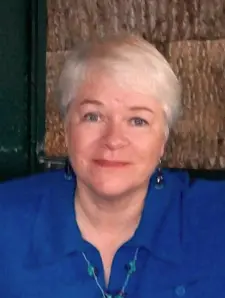
JANE SHLENSKY
One would think that after two years of interviews, we would encounter a slightly less than remarkable human being. Apparently that is not so.
It took us too long to get to
Jane Shlensky
, whose work has been consistently earning “Beautiful Bloom” honors, and rightfully so. Walt and I both admire Jane’s rich narrative creations, as well as her ability to write a completely engaging short poem or prose. We are not the only ones impressed with Jane’s work. Two of Jane’s poems made Robert Lee Brewer’s Top Ten for the
Rispetto challenge
. Her “Impressions” stole the number one spot.
Jane’s
Emptying
grabbed my attention during the 2011 Poem-a-Day challenge, and remains one that speaks to my heart.
Emptying
(by Jane Shlensky)
My mama lost the sky today, standing at the kitchen sink,
Hands in suds, eyes on the backyard alive with bloom, birds, and animals,
The pond reflecting
Leaf and flower, bird in flight, cloud and sky.
Oh, look, so blue! she says.
Blue jays?
No.
The pond?
No. Not the pond.
The hydrangea?
No. No. Now she is frustrated, for she loses words that never come again.
Up, she says, pointing.
Oh! The sky!?
The sky, yes, the sky.
And then, just like that, her eyes emptied and the sky fell clean away.
My mama lost the sky today.
MARIE ELENA
: Jane, the first I can recall noticing your work was at Poetic Asides a couple of years ago, when you shared this heart-gripping poem. Was PA your first venue for sharing your poetry publicly?
JANE
: The PA challenge in 2011 was my “return” to poetry in a significant way. I published poems, essays, and creative pieces in high school and across the years, mostly in literary magazines, teacherly publications, and so forth, but I didn’t think of myself as a poet. I was (and am) a teacher who writes on the sly. A shy child, I took to writing because it was a solitary activity I could do alone. I was charming and outgoing on paper in ways I never was in real life until I learned to be funny. In graduate school, I switched focus from writing poetry to fiction. I think everyone who has read me can see instantly that my poems are long and too often narrative or character-oriented. It’s the fiction germ invading! The MFA program at UNC-Greensboro gave me a good grounding in all sorts of writing, but I felt more successful with fiction at that time. Now when I read my early poems, I wonder whatever has kept me from burning them, but really, I know why I keep them. Every writer needs a fully functioning sense of shame. Lots of my work affords me that.
Nancy Posey nudged me for a few years about joining the fun at Poetic Asides, but I successfully avoided it until April 2011. Like most of the things Nancy and I do together, it was fun—Robert and the other poets were so nice, so talented, so encouraging of new people, and Robert’s prompts were interesting catalysts for memory and expression. I came for the fun and stuck around for all the wonderful things I was learning from you all. (It took me a month to figure out that PA was not Pennsylvania
 .
.
MARIE ELENA
: We have Nancy to thank for introducing you to us? I’m glad she was persistent!
“I was charming and outgoing on paper in ways I never was in real life…” I wonder how many of us can relate to that, Jane (as I sit here nodding my head).
So, what originally drew you to poetry?
JANE
: First and last, my mother, Mary Garner Craver. She wrote rhymed and metered poetry, of home, simple things, hopes, plants, God, faith, survival. We kids helped her publish two volumes of her poetry while she yet lived. The first, Edgewood Poems (our farm was named Edgewood) I keep on my desk so I remember where and whom I came from.
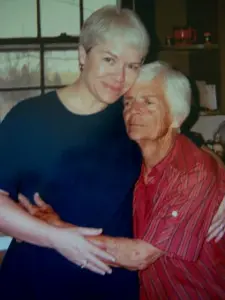
Jane with her mother (Mary Garner Craver)
From
Edgewood Poems
, by my mama, Mary Garner Craver:
Perception
He who can see beauty in the simple
daily things
will not be bored or lonely,
his heart has wings
to rise above the sordid, to find
the pure and true,
and know that blessed contentment
that comes to very few.
MARIE ELENA
: Obviously you come by your wisdom and talent naturally, Jane.
JANE
: I have dozens of “Mama poems” in which I try to articulate her gentle, funny, intelligent, sturdy, loving essence. She was an “old soul,” wiser than a person can become in one lifetime. Anyway, the stanzas hold 7 lines each, one for each of us in my immediate family (5 kids and parents). The last stanza is diminished by one. This poem was published in Beyond the Dark Room last year.
Chances
(by Jane Shlensky)
Some days my memories with you fog,
and I cannot imagine your voice
or mine, as we were when you were
most yourself. Still, my hands are yours,
worn and busy, stained with foliage,
and my hair, white long before its time,
traces a gene back to your mother.
I carry you in me, as I concentrate
on opening earth to seedlings,
trying to sense seasons’ change,
smelling soil and new buds,
spring rains and twilight,
checking old growth bark for new life—
all learned from you.
I gather words together, arranging them
like posies, pruning and shaping
just as you taught me,
a poem helping us share a moment
of observance, a recognition
of overlooked wonders in need
of second chances: the first crocus,
a jay’s feather, a gnarled twig like a cross,
a stone laced with red veins pulsing
the heart of the earth,
a dead hummingbird
curled like a small fist,
lying still and iridescent
among wild flowers.
I know when you became uprooted
from yourself, you longed for death,
but I could not wish you gone;
even knowing all I’d learned
of pain and loss, that death is not
the worst thing, still I could not imagine
a world depleted of you.
I cannot now say “never” in a line
that has you in it. You are ever.
As long as I can remember,
I will feel you living in me,
and take every spring’s resurrection
as a chance to hold you again.
MARIE ELENA:
Oh my … This poem truly does represent your gift with words. I’ve read it several times, and cannot get through it without tears. Your love and respect for your mother is such an inspiration.
If I asked you about your upbringing, what would be the first thing to come to you mind?
JANE
: Work. I’m the last of five farm kids, born (we were convinced) to work. Edgewood was a mixed farm: tobacco, food crops, hay, cattle, pigs, chickens, dogs, rabbits, cats, horses, and the occasional goat. We worked the fields, milked the dairy cows, fed the animal world, did the yard and house work with Mama, canned, preserved, cooked, helped slaughter animals, everything that farming implies. We made most everything we needed, including music and diversion. We were multi-taskers long before folks coined that, and we weren’t talking two things at once, but LOTS of them. To this day, we are all afflicted with an over-developed work ethic. It is nearly impossible for me to sit quietly without doing things with my hands or mind or both. I watch TV with crosswords, novels, to-do lists, or writing materials. I carry calming “toys” with me everywhere so as not to act out in waiting rooms or quiet places. Naturally, I believe in the healing nature of work, in an ethic that gives lives meaning, purpose, and value, that sees what needs doing and does it. I believe in work that helps and uplifts, that puts more back into life than it took out. I think finally our lives will be judged by the work we did and our attitudes about it and whether we tried.
MARIE ELENA
: Impressive, Jane. Frankly, I’m finding the older I get, the less capable I am of multi-tasking.
What would you say is the most difficult situation you’ve had to deal with? What helps you deal with difficult times?
JANE
: My dad used to say everywhere I went there was a revolution, as if I caused them. It was more timing than predilection, but sometimes I have felt as if I had some magnetic pull on misfortune.
I’ve had the usual difficulties humans endure: cancer, divorce, depression, betrayals, falls and breakages, deaths of loved ones, accidents, profound pain, disappointments, and general stupidity. For a while it was a struggle for Volodya and me to be together. He was Soviet and once we left China, we had no assurances that we’d ever see one another again. That was hard at the time, but also instructional. I think of myself as pretty average. During each major challenge of my life, whether life-threatening or the result of my own foolishness, I do what most folks do: cry my heart out, pity myself, pray, give up, curse my fate, stand up, and get on with it. Pain and pity are boring for both the host and the sympathizer, too confining and no fun.
My niece told me once that I should announce to my students that I suffer from depression, that it would help students who had the problem. I pointed out that while I’m sensitive to students who struggle in that takes-one-to-know-one way, such a disclosure would limit who I could be to them and to me. I would become “that depressed teacher” and little else. I think that’s true of any hardship or misery. Each one introduces its own limitation to my life. I could whine about that eternally and be defined by the problem, or I can feel it, suffer it, suck it up, and get on with living. Besides, I think I’m pretty cheerful for a depressed person.
Care-giving my parents as they slowly suffered and died, my siblings and I learned that death is not the worst thing in the world. When my sister, Alice, had leukemia, I was her bone marrow match. Her death haunts me still, for she was 62, my age now, just entertaining retirement, and I fervently believed that my cells could save her, that I could help. We cannot always do. Sometimes we can only be, and that’s so hard. I mourn that my bones and hers could not give us more time. Perhaps, I’ve become stoic. I don’t want to give much life to things I cannot change. I would rather love my life whatever it is, joyous or mean, to the dregs. I don’t talk a great deal about my faith, but I have it, own it, struggle with it, and rely on radical mercy and grace. I reckon good philosophy can get us over many a rocky patch, no?
MARIE ELENA
: I knew your parents had passed on, but I don’t remember knowing about your sister. “We cannot always do. Sometimes we can only be.” A tough realization sometimes, but wise to acknowledge. Bless your heart.
You mentioned China. Do I understand correctly that you once taught there? What can you tell us about the people and experience?
JANE
: You know, Marie, so many of my world travels, especially my adventures in Asia and back-packing in Europe, seems as if it happened in a novel or to someone I once knew, rather than to me. Yes, I taught in China from 1988-1990, the years of the student movement, the Tian’an’men massacre, and the subsequent “re-education” of students on college campuses. Before China, I was an English teacher and theater director, meaning I taught all literatures, grammar and comp, all creative writing courses, and publications to boot. With that background, I felt I could teach anything, anywhere. I was hired by the Chinese government to serve as what they called a foreign expert in writing at Shandong Teachers’ University in Jinan, Shandong, PRC. I taught undergraduate English majors both composition, conversational and Business English, and they taught me so much I cannot begin to list it. I still have a file folder of short but wonderful writings they allowed me to keep from their journals.
All the foreign teachers were asked to give evening lectures to English majors occasionally on any subject we chose; those evenings were always standing room only and very informal. I taught them songs, and we made joyful noises aplenty. I had my dulcimer with me, carried a kazoo at all times, and sometimes had access to a piano, so we could really jam. All my students were tracked to become English teachers somewhere out there in China, something they felt to be an exercise in powerlessness. Maybe a farm girl from North Carolina could convince them that life of the mind
is
power. Teachers are so powerful it scares me sometimes; we have the power to direct our students toward their dreams, to clear away the cobwebs of doubt, and let them see themselves as we see them. If that’s not power, what is? I loved them. But then, I’ve loved other people’s kids for almost 40 years, and although it’s sometimes trying, it is never useless. We had good discussions about the roles of teachers, the pay, the joy, the hardship. It took me a while to convince my Chinese students that money is only one form of power— that free thought, expression, creativity, and love of one’s work in the world are all better than money, as long as you don’t starve.
At that time, Chinese cities (even with massive populations) were more provincial, shorter, not so many sky-scrapers; the millions rode bicycles or over-crowded buses, as few could afford cars. The difficulties were predictable and therefore nothing to whine about. The heat came on twice a day, as did the hot water. Get up late and you missed it. My housing unit was 3 small rooms—very spacious for China—with ornamental TV, refrigerator, air conditioner, and phone—visible but not functioning well. Over twenty nations of students and a few teachers from across the world lived in my compound, surrounded by a wall, entry only by signing in and out with the guards. Almost weekly, someone somewhere that one of us loved had a birthday or national day or memorial we needed to celebrate with that culture’s foods and songs and dances, all inside our “fortress.”
I thought about Frost’s “Mending Wall” often during that time: “Before I built a wall I’d ask to know/ What I was walling in or walling out,/ And to whom I was like to give offense.” It didn’t take long to realize that we were both walled in and walled out. They kept close records of any persons who visited frequently, of how long they stayed, that sort of thing, because we weren’t trusted not to corrupt China with our democratic ways; my unit was bugged, so my guests spoke in whispers or wrote messages to me as we visited. It was a huge irony—I’m generally fond of ironies—that I would be brought so far to teach students to think and write freely when those very skills were suspect and would never be allowed in their daily lives.
That’s what hurt me so about the massacre itself. Those students who had been taught by people just like me to stand and speak, to think and write, to create and imagine—they were set up for failure and for punishment for learning well their lessons from us. That tragic end to the student movement came in June. I stayed until mid-July to give final exams when the government ordered students back to classes, then I came home for my parents’ 50
th
wedding anniversary, unsure if I would be allowed to return to PRC. Finally, the tickets came through and I returned to witness the aftermath of that movement: students forced to re-education, i.e. political classes where they were trained to say nothing happened, that what they had experienced did not exist, that Communism was the best of all possible worlds. That was hard to watch, especially when some of them corrected me for saying that it surely did happen and that I witnessed it myself. I told a student at that time, “I’ve seen the dark underbelly of China this year; I want to return to try to understand what I know.” Of course, I had a good Soviet tutor the second year, a sweet little man from Uzbekistan, who has been my husband of 22 years. As a Soviet Jew from Uzbekistan, my Vladimir was not the best spokesman for the communist way, but he did help me understand how much freer China was than the USSR, something I would see when I visited the USSR prior to our marriage. It forced me to consider that when we think we’ve hit bottom, it’s only because our imaginations are so limited. When I hear folks complain that something cannot get any worse, I feel that ironic pinch and remind them that circumstances can always be worse. Always.
Despite hardships, I loved China then and now. I didn’t go there to love it, but I discovered that when you enter a place and a people with no preconceptions and no expectations, they are freed to be who they are, to accept you for who you are. It just makes for a more loving relationship from the get-go. Over the years, teaching Asian Studies, I’ve imagined that Lao Tzu, founder of Taoism and writer of the
Tao te Ching
, would have approved of my “uncarved block” ignorance and what it allowed me to give and learn from China.
I’ve been back twice, though never to Jinan. I still hear from a few of my old students but each year, I lose a few more to time and space. I have faith that they know I valued them. Love is elastic like that. I published an article in a new Chinese magazine called
Openings
that first year about my first impressions of China and was told repeatedly that I must not write anything critical. “Propaganda, then?” I asked them. “Oh, no, no—just nothing critical.” That article was called “Love Is All There Is.” The last words my mother said to me before I left for China, her final advice that I cherish to this day was, “Love is all there is. Nothing else is important.”
One more story and I’ll shut up about this. There was a visiting professor from a major American university that came to lecture in the English department at my university for 3 weeks. He employed me briefly to help him make tapes for language studies. He suggested to me that I must be simple-minded if I enjoyed teaching in China, for he despised the country and the people. He called me “Pollyanna.” I told him, “I’m not so Pollyanna as you imagine. I see as Sancho Penza, but I feel as Don Quixote.” In essence, I see realistically what is before me, but feel idealistically about what the world might be with a little tilting at windmills. He asked if he could have that line, but I told him to write his own damned lines and go home if he couldn’t appreciate where he was. I have a mean little mouth on me.
MARIE ELENA
: Go Jane! Someday I’d like to sit across the table from you and hear more stories from China. Your life-stories are amazing, and your story-telling qualities shine brilliantly.
Do you still teach? What got you into that line of work?
JANE
: My mother looked upon teaching as a fine fallback position for my aspirations to be a writer. Mama was a poet herself, more as therapy than profession. She encouraged me to get my teaching certificate to have something to fall back on. I joked with her that I’d been falling ever since. But I think perhaps she knew me better than I did. When I advised a club of Future Teachers my first year teaching, they insisted on creating a float for the homecoming parade with a banner that read, “Touch Humanity—Teach!” Lord, I still get choked up over that. That was exactly what I felt about teaching. To teach well, you have to get down among your students, be willing to learn from them, share with them, get angry and get over it with them. I love teachers (and who imagines they are not teachers?) and feel it is the noblest of endeavors. I cannot imagine another profession that would have kept me as honest as teaching has. You cannot kid the kids—not as parents or teachers. You can only come clean, be real, be true, own your mistakes, ask pardon, try harder—hell, LEARN. You have to model the thrill of the chase, the life of the mind, and mean it. What a wonderful humbling ideal to be held to!
I’m trying to let go of teaching. I retired in 2006 from a residential high school affiliated with the University of North Carolina, the NC School of Science and Mathematics. It was the first school of its kind in the country—funded by the legislature for gifted junior and senior students across the state. I had taught for 34 years, one place or another, and frankly, an English teacher spends life under paper, all those essays and research papers. The same year I retired, a friend at the local technical community college called and asked if I’d like to teach a few classes there, so I did, and have continued off and on. I love to teach, but the constancy of marking papers is a deal breaker.
I worked with the Teaching Asia Network for a few years after retirement doing teacher seminars on how to teach Asian Studies (which I’d taught for 15 years). I go into classrooms all over the place when teachers ask me to help them turn classes on to all things Asian or world religions. Developing the Asian Studies course for NCSSM helped me land a few grants and fellowships to study in Asia, in Japan, Korea, Malaysia, Singapore, Thailand, Borneo, India…there is nothing better than traveling and studying on other people’s money. I got to meet Mother Teresa in Calcutta and handle snakes in Vietnam. (See picture at
http://www.flickr.com/photos/jshlensky/2921416301/
). Those study trips were such blessings to me and changed my life in and out of the classroom. I’m convinced that full-contact teaching is something you don’t get over so easily, like a great love affair that was at once hot, sweaty, beloved and painful, troubling, and heart-rending. I teach Sunday school some now. I can’t seem to get over teaching and have considered it is not so much what I do but what I am. There is no learning like teaching, and I love to learn. But papers? You can keep those.
MARIE ELENA
: Have you ever pondered how a farm girl ended up being so well traveled and, well, lifed? (Not a word? Should be. It fits).
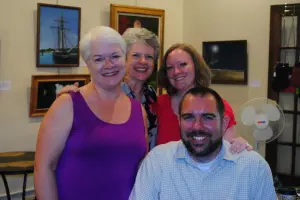
With Nancy Posey, Tammy Brewer, and Robert Lee Brewer
Now for a confession: I’ve been stealing from you. I stole this photo of you, Nancy, Robert Lee Brewer, and Tammy Brewer at Poetry Hickory. I’d love to know what Poetry Hickory is all about. Spill it, kiddo!
JANE
: North Carolina calls itself “the writingest state” because there are so many good writers who call the state home. There are little klatches of writers, near universities often enough, that encourage and help one another; the state and its writers are very welcoming and kind to new and young writers. Poetry Hickory in the western part of the state has some very dynamic writers, like Scott Owens and Jesse Carty, who organize such events. Robert and Tammy’s visit was a coup for Scott, bless him; Robert offered a session about getting our work out to publishers which was helpful for lazy folks like me. Then, Nancy and I were privileged to be the warm-up act before Robert and Tammy read. It was wonderful to meet and share with them and hear their poetry. They may be the “writingest” couple around.
MARIE ELENA
: How cool! And yes, I am jealous.
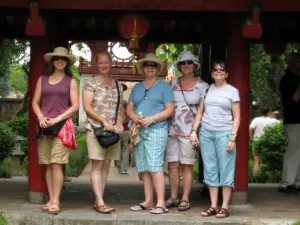
At Temple of Literature, Hanoi
Another photo I stole is this Temple of Literature photo in Hanoi, Viet Nam.
JANE
: As I mentioned, I worked with the Teaching Asia Network of North Carolina, grounded at UNC-Chapel Hill, as an academic director of seminars for teachers who want to incorporate Asia into their courses. After teachers had taken a seminar, they could apply for a travel program to take them to Asia. In 2008, we took 20 teachers to China for two weeks and Viet Nam for 2 weeks, during which I was the “China Mama,” helping them barter in Chinese, get lost and find our way, do research on sundry topics that would help in the classroom. That was my first trip to Vietnam, another place I love. Since I had wanted to go to Cambodia for a long time to visit the temple complex at Angkor Wat, the coordinator asked if I’d be willing to accompany teachers who would pay out-of-pocket for it. Why not? So we had half of the group stay on for a week in Cambodia. That’s 5 weeks of fun, fierce heat, and developing friendships. That picture was of the English majors in the group, some of whom did sessions for English conferences with me once we returned to the US. There are other fine photos of that trip at this site for those who are considering a jaunt to Asia (
http://www.flickr.com/photos/jshlensky/
). The friendships I made on that trip were added to my collection of good people; several of us still get together for wine, good food, book talks, and general hilarity. What wonderful women!
MARIE ELENA
: And then there’s the Swannanoa Gathering. I LOVE this photo!
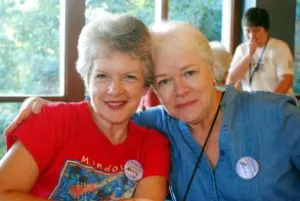
With Nancy Posey
JANE
: I see you’ve been to my Facebook page, home of unflattering pictures of me that other people insist on posting. Actually, that’s a funny story too. Nancy and I have been conferencing buddies for years, 20 or so? We were both on the board of directors for NC English Teachers Association for…ever. We learned that we play off one another well and began to do sessions at state and national conferences. We were in San Antonio for NCTE standing in line for wine, bickering as usual, and a lady behind us asked if we were sisters. I told her, no, we’re old friends. I had retired already so conferences come out of my pocket. I said, I’m ready for the cruise portion of our friendship and Nancy’s still hung up on conferences.
Nancy called me in August and said, I think I found our cruise—which of course was not a cruise at all, but a music camp at Swannanoa in the mountains, a week called Old-Time Music and Dance, traditional music on largely stringed instruments. Nancy plays mandolin, and I got the inspiration to have my dulcimer fixed and cruise on up to the mountains for a week. It was the kind of howling I enjoyed in my youth—music, dancing, learning, jamming, concerts, more dancing and jamming, Tai Chi, classes, meals, exhaustion, and more fun than monkeys in a barrel. I learned a greater fluency on dulcimer, though I have a long way to go. I came back and started a group at my church called the Stringfellows. We play and sing and laugh lots and sometimes perform for services. An old teacher habit: no experience should be wasted. My especial gift here is that I play poorly enough that I can encourage anyone else to exceed my level. I can teach anyone everything I know in fifteen minutes. It’s fun. I decided to learn guitar and autoharp, so I can play them just as poorly as I play dulcimer. I also play piano and organ for church, but I can’t carry them around.
At a conference in Orlando, Nancy brought her mandolin and I brought my keyboard. One evening we had dinner and stayed in playing and singing until, um, late. We expected our neighbors to bang on the walls and yell at us, but nothing happened. We decided either they were out, deaf, or optimistically, we were just that good. Now, we’re even better.
MARIE ELENA
: You and Nancy really know how to have a great, enriching time together! If you could spend some time with one living poet besides Nancy, who would you choose?
JANE
: Oh, my. Brain freeze. I can barely choose an ice-cream flavor when confronted with multiple flavors. I love Ted Koozer, our past national poet laureate, who is just the sweetest human being, poet, and encourager of poets. I met him at a conference and got on his mailing list so I receive great poems from him weekly, from the poets he is reading. He has a heart for the simply beautiful and true—and agrarian, that speaks to me. I love the ease of poets like Billy Collins and Fred Chappell, my old MFA advisor, whose poetry is conversational or finely sculpted. Heck, I wouldn’t mind a sit-down with you, Marie, with a side dish of Walt and William Preston and all these dear sweet Bloomers and PA folks I’ve come to admire. I know I’ve hit a winner when I read someone and say, “Man, I wish I’d written that.” Every writer I read is a little world with a window I can peek through. Not only do I get to experience life as they see it, but my angle of vision and the way I express my own experience is honed. It’s a divine trade.
MARIE ELENA
: You just put a huge smile on my face, Jane. So now it only seems fair to ask, if you could spend time with one no-longer-living poet, who would you choose?
JANE
: I hope if I have to endure a repository for souls, it will have a sort of pub with comfy chairs where I can sit around with dead poets and writers, philosophers and artists and ask questions and discuss things, argue a little, laugh at how well or ill things turned out, have a sort of eternal reading or poetry slam. I could sympathize with Plath and Eliot, listen in on Virgil and Frost, drink one too many with Li Po and Bukowski, let Pushkin, Lermontov, and Yevtushenko slam it out with Yeats, Keats, Arnold, Dickinson, Rilke—lord, you’re blowing my mind here. I think at the moment, I would love a hug from Walt Whitman. His poetry has been hugging the world anyway. I admire his “hail friend well met” inclusion of all things, all people, seeing sparks of divinity everywhere he looks. I admire good poets, but I love good people.
MARIE ELENA
: You’ve indicated that you might be interested in starting a blog. What would a Jane Shlensky blog include, and what would make it stand out in a crowd of writer-ly sites?
JANE
: Oh, my. By now, you and Walt know me for the hypocrite that I am. I love your blog and listen attentively when people tell me how easy it is to get going, then I nod as if I’ll do it and ignore everything I’ve heard. That said, I announced that this is the year, so I made some half-hearted effort at designing a blog that might be different, although there are so many good ones out there, I cannot believe I have anything new to offer. I tinkered with names and have decided on a few, for features in the blog and perhaps for the blog itself: Poetonics and Poetically Re-formed (which is really more PoetRonics, the mechanics of form). The Poetonics feature and its prompts would focus on poetry as therapy and thanksgiving, as tonic for the poet and the reader, how to view the good in negative experience as a catalyst or cure for what ails us as individuals, cultures, and humans. The Re-formed feature keeps shifting on me. I love poetic forms, even when their limits cause me to write some barbarous poetry. I like the play of them, the tinkering and counting and honing. So that part was to incorporate a form prompt, but offer another poem or a short piece of prose to be remade into the poetic form. So many folks have poetic forms already. I wanted to use art, photography, and other forms of writing as catalysts for trying a new form. Does that make sense? I’m still tinkering, but I’m not convinced that the world needs a Jane Shlensky blog. If anyone wants to join a serial procrastinator for such a blog, give me a yell. I play well with others and need a pal to inspire me.
MARIE ELENA
: Yes, I think the world DOES need a Jane Shlensky blog.
Now finally, if there was only one thing we could know about you, what would you choose to tell us?
JANE
: Your questions are so difficult and yet so, well, therapeutic. Just trying to answer them is like writing my own eulogy, uplifting but disturbing. I guess from what I’ve already said, you may have discerned that I love things, people, plants, ideas; I love following the fun of learning and appreciating things. I used to say I’d try anything 3 times, just in case two of them were ill prepared. When I think of people who complain their lives away, I wonder why they never located the fun in existence. Even in suffering, there is always a little moment when the absence of pain is delightful and joyous, when breathing deeply is gift. Some girlfriends and I decided we should make T-shirts with our slogans on them. Mine was “I just want to play and have friends.” That made them laugh. The real slogan that I hope to live into is, “I want to be of use”. I don’t want my life to be in vain, useless, selfish, wasted. But that’s not as catchy, is it?
My friends—old, real, new, digital, familial—are wonderful blessings in my life and help me discover my own capacity for joy, for love, and for endurance. I do believe we are all in this life to learn to love and that the proof of our success in that endeavor will not be who loved us, but whom, how, what, and how fervently we loved. This interview and your wonderful blog is a case in point. Other than Nancy, I know none of you, and yet you embody the heart of kindness, of sharing, of humanity and service and love. What else do I need to know about you? It would be so much fun to sit down with a libation and visit with each one of my digital buddies, but I don’t need that to know what you mean to me. If I can look God in the eye and say, Sir, if you’re gracious enough to overlook the stupid stuff of my life, maybe I can be redeemed by the fact that I loved with all I am, flawed though it was. And if I deliver substandard love to the world, maybe I’ll get another lifetime to get it right and be used to nothingness. I believe in lots of chances.
MARIE ELENA
: Jane, it has been an absolute pleasure getting to know you better. Thank you for gracing our site with your talent, and for a wonderfully engaging interview. Consider yourself cyber-hugged.
Like this:
Like
Loading...